
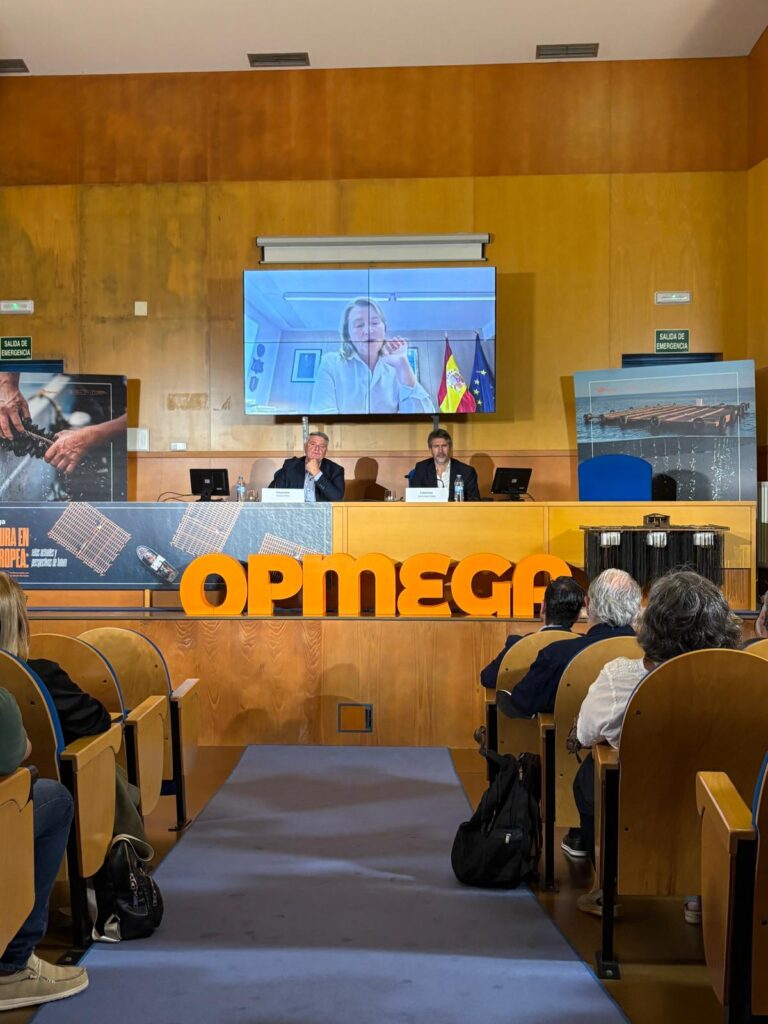
Opmega brings together the FAO, Eurocamara and the mussel industry in Vilagarcía to strengthen the voice of the Galician mussel industry in Europe
The conference “Mussel farming in a European context: current challenges and future prospects” addressed food fraud, origin labelling and the functioning of EU institutions, and paid tribute to Manuel Castro Paz, a mussel harvester from A Illa de Arousa known as Manolo Pescador, for more than five decades dedicated to mussel farming
Opmega’s president, Ricardo Herbón, highlighted in his speech the quality of the product marketed by its members: “We have pure gold in our hands and we must showcase its value”
Vilagarcía de Arousa, 29 May 2026.—The Galician Mussel Producers’ Organisation (Opmega) held the conference “Mussel farming from a European perspective: current challenges and future prospects” this Friday at the Edificio Mejillón de Galicia, a meeting that brought together representatives from the FAO, the European Parliament, central and regional government, the fishing and canning sectors, and the mussel-farming industry itself to analyse the impact of EU decisions on day-to-day operations at the mussel beds.
Official opening
The president of Opmega, Ricardo Herbón, opened the meeting by highlighting Galicia’s status as Europe’s leading mussel producer, well ahead of Italy and Greece, and emphasising that much of the legislation affecting the sector—such as labelling, environmental regulations and food safety—is decided in Brussels. “Although our activity is local, the decisions that affect us are made in Europe. That is why it is vitally important to understand how the European institutions work and to be present wherever we can make our views heard,” he said.
Next to speak, via a recorded message, was the Secretary General for Fisheries at MAPA, Isabel Artime, who highlighted Opmega’s leadership within the mussel sector and praised its commitment to sustainability and innovation. Artime agreed with the organisation that a presence in Brussels is essential: “It is essential that we actively contribute to the European debate so that there is a coherent and uniform aquaculture policy within the framework of the Common Fisheries Policy.”
The opening session was brought to a close by the mayor of Vilagarcía de Arousa, Alberto Varela, who also highlighted Opmega’s leadership role and its commitment to sustainability and innovation as hallmarks of the sector. Varela emphasised that the future of the Galician mussel lies in Europe: “The path to reaching the rest of the world begins in Europe. That is where the doors are opening and where we need to
Food fraud, traceability and European institutions
The first presentation was given by Esther Garrido Gamarro, a fisheries officer in the FAO’s Fisheries and Aquaculture Division, who presented the study *Food fraud in the fisheries and aquaculture sector* and outlined the main types of fraud affecting seafood products on a global scale.
The UN expert explained that the sector produces over 185 million tonnes of aquatic products annually, a scale that makes it particularly vulnerable to food fraud, ranging from species substitution to document manipulation within the supply chain.
In the specific case of mussels, Garrido Gamarro identified the main risks as the fraudulent marketing of farmed products as ‘wild’, the misuse of sustainability certifications, and misleading claims regarding geographical origin or production methods.
Next, Natalia Fontaina Rey, Head of Management at the Aquaculture Cluster Technology Centre (CETGA), presented the European FishEUTrust project, funded by the Horizon Europe programme and led by a consortium of 22 partners from 14 EU countries. The project aims to strengthen traceability and consumer confidence in fishery and aquaculture products through authenticity tools based on genetic biomarkers, stable isotopes and freshness sensors. In the case of mussels, the results obtained to date already allow farmed and wild products to be distinguished with 85% accuracy when isotopic and multi-elemental analyses are combined.
After the break, Cécile Fouquet, founding partner and director of Aliénor, gave a presentation on how European institutions actually work and the specific channels through which a productive sector such as the mussel industry can make its voice heard in EU decision-making. Fouquet outlined the key players in Brussels and the two main areas of action where Opmega has scope to exert influence: origin labelling for processed products and protection against competition from third countries, particularly within the framework of the trade agreement with Chile.
The expert emphasised that, although regulatory change in Europe takes time, the current political climate is favourable to primary sectors and mollusc aquaculture as a source of protein with a positive environmental impact.
The importance of having a presence in Europe
The event continued with a round-table discussion moderated by Lino Suárez, Director of Operations at Opmega, featuring Nicolás González Casares, MEP for the Socialist Group, and Yobana Bermúdez, Director General of Conxemar and Chair of the Markets Advisory Council (MAC). The debate addressed the tools available to the Galician mussel sector to defend its interests before the European institutions, with particular focus on origin labelling and the impact of Chilean mussel imports on the EU market.
A tribute to Manolo Pescador, a living memory of the fishing industry
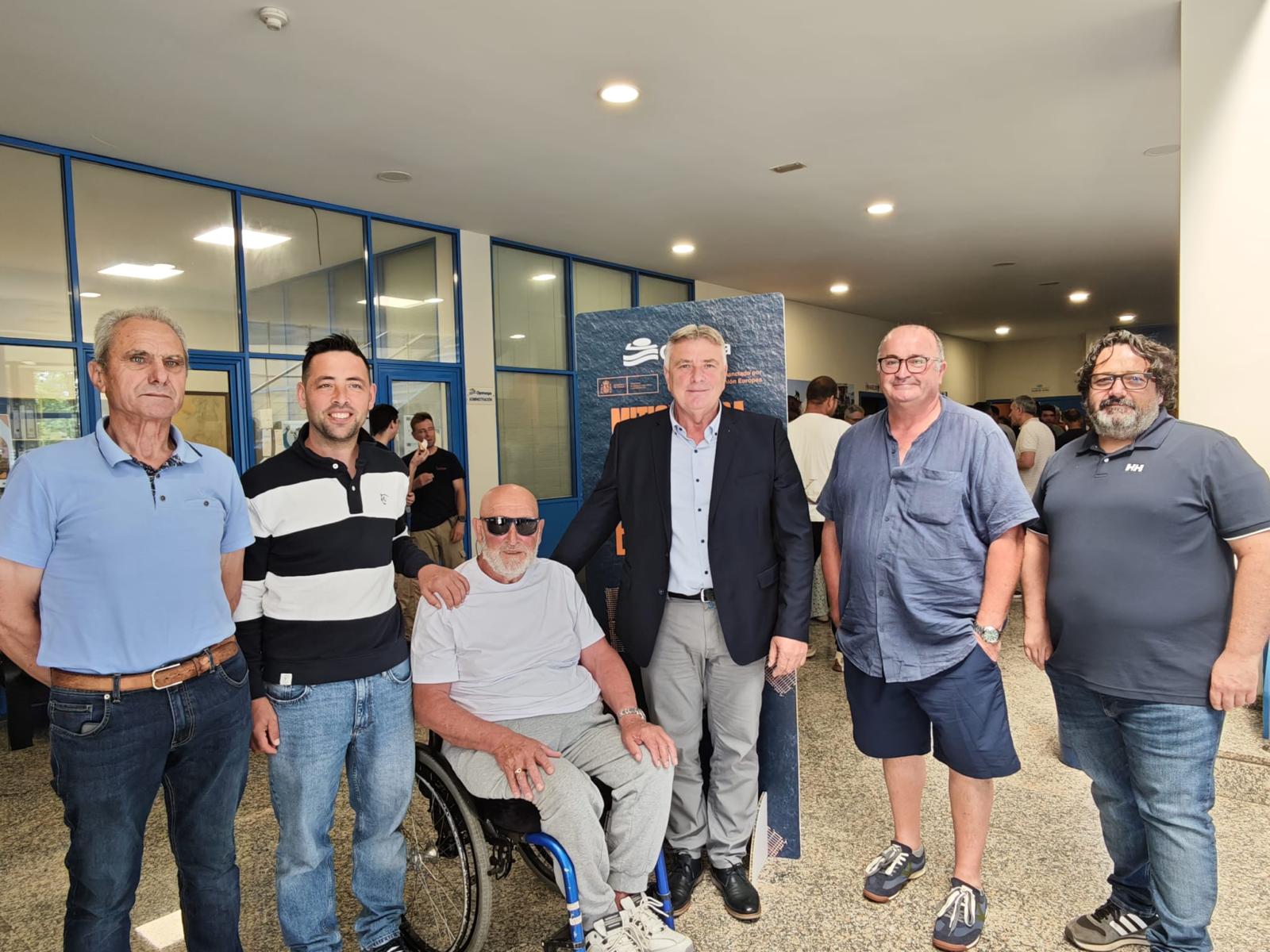
Before the closing ceremony, Opmega paid tribute to Manuel Castro Paz, known as Manolo Pescador, a mussel farmer from A Illa de Arousa, for a lifetime dedicated to mussel farming and for his commitment to the sector through his involvement in the industry’s associations.
Manolo began working on the mussel rafts in 1973, at the age of fourteen, accompanying his father on the Arousa estuary. He combined fishing with mussel farming for seven or eight years before devoting himself exclusively to the rafts for a decade. He retired at the age of sixty, though he never completely stepped away from the industry: he has spent thirty years on the boards of sector associations and remains a mainstay of the A Illa Association, convinced that unity is strength.
He keeps abreast of the issues affecting the sector—imports of Chilean mussels, falling yields—and remains deeply committed to the industry and concerned for a trade which, in his words, is more than just a job. Of his four children, three are still involved in the mussel industry, a family tradition that is the norm rather than the exception on A Illa.
“We want to highlight the career of the mussel farmer who went through every stage of the trade, witnessed the organisation of a sector that for decades operated without structure, and who, now retired, maintains his commitment to the association intact,” said Ricardo Herbón as he presented him with a gift in recognition of a lifetime’s work.
In his closing remarks, Ricardo Herbón summed up the day’s proceedings and highlighted the value of Galician seafood: “We must realise that the seafood we harvest from the sea is pure gold. We have pure gold in our hands and we must showcase it, raising awareness of its socio-economic importance for us, for our families and for our region”. The president of Opmega concluded by emphasising that “the key lies in having a presence in Europe to fight for all those issues that may pose a threat to our sector”.
The conference was officially closed by the Deputy Mayor of Vilagarcía, Tania García, and the Regional Minister for the Sea of the Xunta de Galicia, Marta Villaverde, who called for more European support, with less bureaucracy, greater regional involvement and stable funding for fisheries and aquaculture. She thus advocated for the recognition of aquaculture as a primary sector and the continuation of funds such as the FEMPA to ensure its competitiveness.
The event concluded with a mussel tasting featuring various recipes by chef Miguel Mosteiro, with a culinary offering that combined tradition and creativity centred on the organisation’s star product.
The event forms part of Opmega’s Production and Marketing Plan, co-financed by the Ministry of Agriculture, Fisheries and Food (MAPA) and the European Maritime, Fisheries and Aquaculture Fund (EMFAF).
El encuentro concluyó con una degustación de mejillón con diferentes recetas del chef Miguel Mosteiro, con una propuesta gastronómica que combinó tradición y creatividad en torno al producto estrella de la organización.
La jornada se enmarca en el Plan de Producción y Comercialización de Opmega, cofinanciado por el Ministerio de Agricultura, Pesca y Alimentación (MAPA) y por el Fondo Europeo Marítimo, de Pesca y de Acuicultura (FEMPA).