
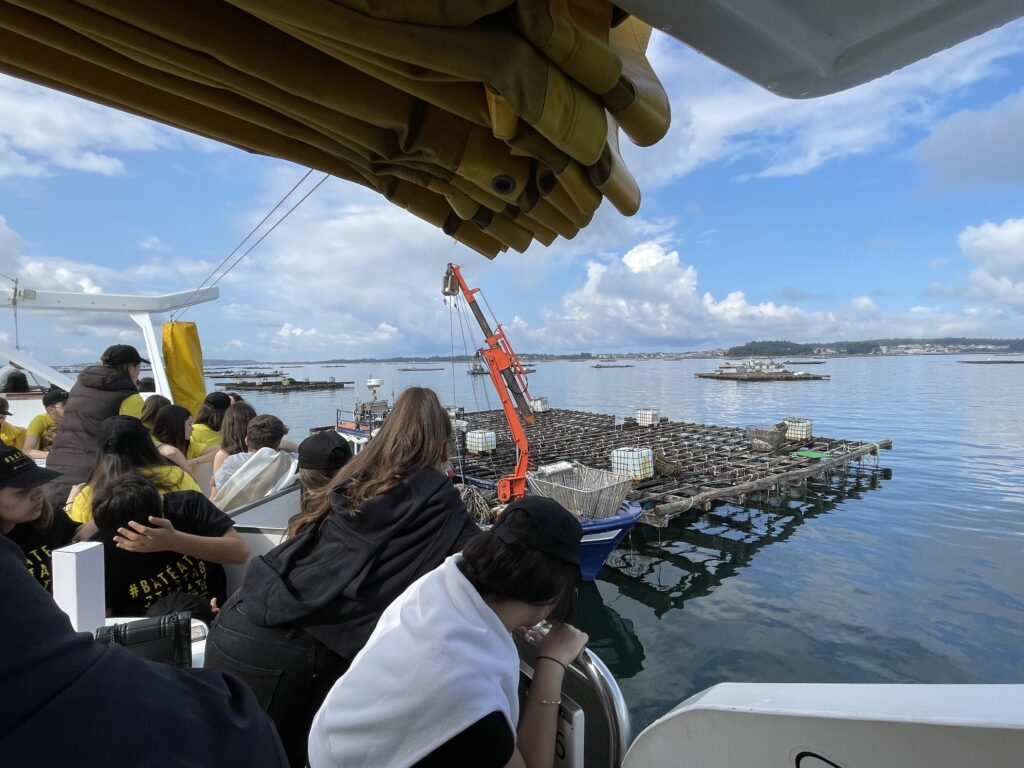
OPMEGA CALLS ON THE XUNTA TO HIGHLIGHT THE ENVIRONMENTAL VALUE OF MUSSEL RAFTS IN BRUSSELS
The organisation is calling for the IIM-CSIC study on the ecosystem services provided by mussel farming to form part of Galicia’s arguments in the negotiations on the 2028–2034 European financial framework and the reform of the Common Fisheries Policy
Opmega also calls for this assessment to be incorporated into the study on the carrying capacity of the estuaries commissioned by the Xunta from the USC, which is due to be completed this year
Vilagarcía de Arousa, 16 September 2026. Opmega is calling on the Regional Ministry of the Sea to incorporate the environmental value of the mussel rafts – which has already been quantified by the CSIC’s Institute of Marine Research – into the position that Galicia is advocating to the European institutions. The producers’ organisation is thus responding to the call for unity between the sector and the authorities made in recent days by the Regional Minister, Marta Villaverde.
Previously, Villaverde had called in the European Parliament for a minimum allocation of 7,290 million euros for fisheries and aquaculture within the 2028–2034 multiannual financial framework. For Opmega, these negotiations and those concerning the reform of the Common Fisheries Policy are precisely the areas in which the scientific research commissioned by the organisation can prove most useful.
“We agree with the regional minister that we must present a united front in Brussels. What we are asking is that she puts forward the strongest argument we have, and right now that is this: mussel rafts not only produce mussels, they also help to preserve the estuaries, and this is no longer merely the sector’s opinion – it has been measured by the CSIC,” says Opmega’s president, Ricardo Herbón.
The study referred to by the organisation, “Mussel farming: a sustainable activity. Assessment of the ecosystem services provided by Opmega’s mussel farming”, was carried out by researcher X. Antón Á. Salgado, from the IIM-CSIC, and by consultant Ana Vila, from Inxenia, with the collaboration of J. Severino P. Ibánhez and Nicolás Villacieros Robineau. It forms part of the organisation’s operational plan and is co-funded by the European Union. It is the first study to comprehensively measure the benefits generated by mussel rafts beyond food production, across four categories of ecosystem services: provisioning, regulating, supporting and cultural.
Among its conclusions are the low carbon footprint of mussels compared to other sources of animal protein, the contribution of mussel rafts to water quality through filtration and nutrient retention, the use of mussel shells in sectors such as agriculture and construction, and their role as an alkaline reserve against ocean acidification, as well as their protective effect on the coastline and the significance of the activity within the maritime culture of the Rías Baixas.
Opmega’s second request looks inwards, towards home. The Xunta commissioned the University of Santiago, through the iARCUS and CRETUS centres, to carry out a study on the carrying capacity of mollusc farming in the Arousa and Muros-Noia estuaries, which is due to be completed this year.
The organisation believes that such work would be incomplete if it were to measure only the impacts of cultivation and not the services it provides, and calls for both aspects to be assessed jointly before decisions are taken on the management of the farming areas.
Import of non-native mussels
Opmega is once again raising a third issue that has been pending for some time: the entry into the European market of imported mussels that are not subject to the same tariff regulations. The organisation maintains that the entry of tariff-free products seriously harms Galician mussels and the industries that rely exclusively on our product.
“We’re not asking for preferential treatment; we’re asking that what we do counts,” adds Herbón. “If Europe wants sustainable food production, it should look to the Galician estuaries, and what it finds here should have an impact on the allocation of funds and on market rules.”