
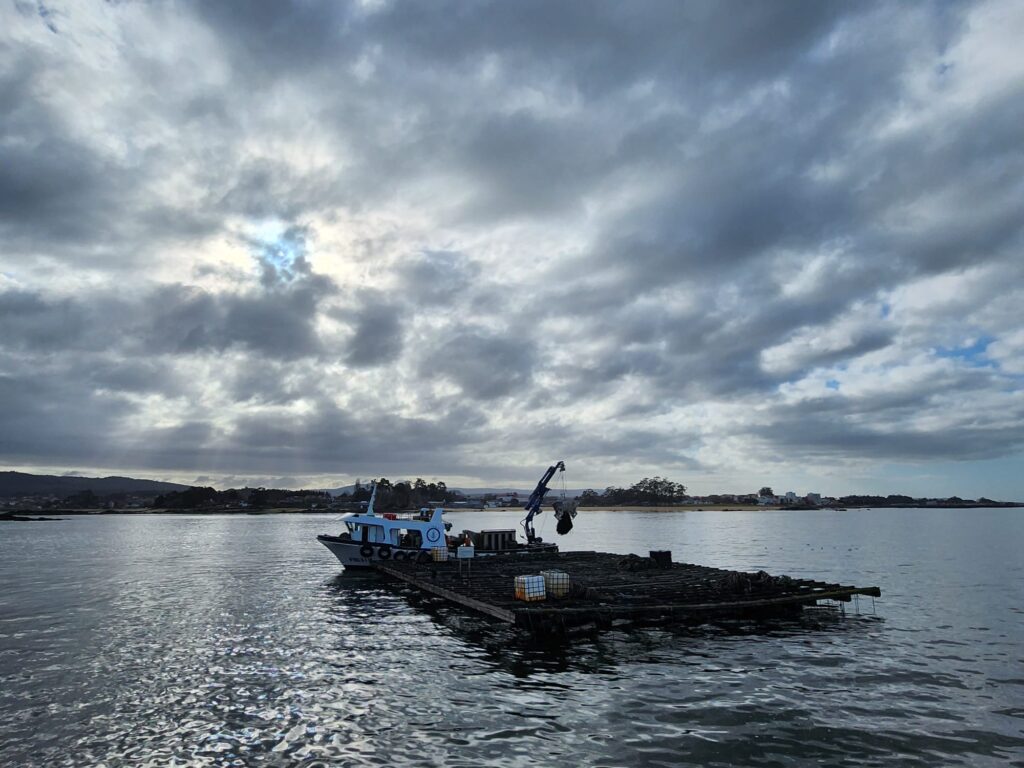
Inequality for Galician mussels: Opmega demands fair rules for all in Brussels
Opmega denounces in Brussels the lack of control and traceability of imported mussels
The transnational organisation based in Vilagarcía warns that the sector has been competing at a disadvantage for years while the Chilean product enters without tariffs or clear information to the consumer.
Vilagarcía de Arousa. 28th July 2025. There are things that accumulate. Opmega, the Galician mussel sector’s reference organisation, has recently taken a concern to Brussels which is not new, but which can no longer be ignored: we cannot talk about fair competition when the rules only apply to one party.
During several meetings in the European Parliament, with MEPs, with representatives of the Directorate-General for Trade, the Directorate-General for Fisheries and the European Commissioner’s office, the Opmega delegation gave voice to what many producers have been saying for years: while every EU requirement is met here, mussels from abroad enter freely, without tariffs and without even indicating their origin, being a different species.
And the truth is that this has consequences. It is not just a question of price. It is, above all, a constant wear and tear for those who do things well and see how their product loses value compared to another that seems the same, but is not. And that, in a sector that supports thousands of families in the Galician estuaries, ends up taking its toll.
“Here, environmental, health, quality and labelling standards are complied with… And meanwhile, others arrive without explanation. The question is: does this seem normal to us?”, added Herbon,
During the visit, Opmega handed over a document with data showing how this situation has a direct impact on employment, production costs and the future of the rafts. It also put forward concrete proposals: activating safeguard clauses, revising labelling rules and ensuring that the consumer is no longer the last to know.
The European institutions showed interest and a willingness to listen. But they were also cautious. Changing certain dynamics is not easy. That is why Opmega insists: this cannot remain a round of good intentions. Clear, visible and effective decisions are needed.
The organisation has already initiated contacts with the Xunta and the central government to request a firm position in Brussels. And in the coming weeks it will also activate a public campaign to put the focus where it is needed: on the need for transparency, justice and respect for what is produced here, with effort and commitment.
“We are not asking for privileges. We are only asking that those who cheat should not be rewarded. Because if anything goes, what is at risk is not only our sector: it is people’s confidence in what they eat,” concluded Herbon.
About Opmega
Opmega brings together more than 300 producers in the Galician estuaries and represents a large part of European mussel production. With a sustainable model, linked to the territory and with a direct social impact, it is today one of the key structures of the sea economy in Galicia.